How Hill Country Slopes and Rock Soils Affect Gutter and Drainage Design
Practical guidance for homeowners in Kerrville and the Texas Hill Country on how steep slopes and rocky soils change gutter placement, downspout strategies, and erosion control—and how First Due Gutters and Roofing approaches those challenges.

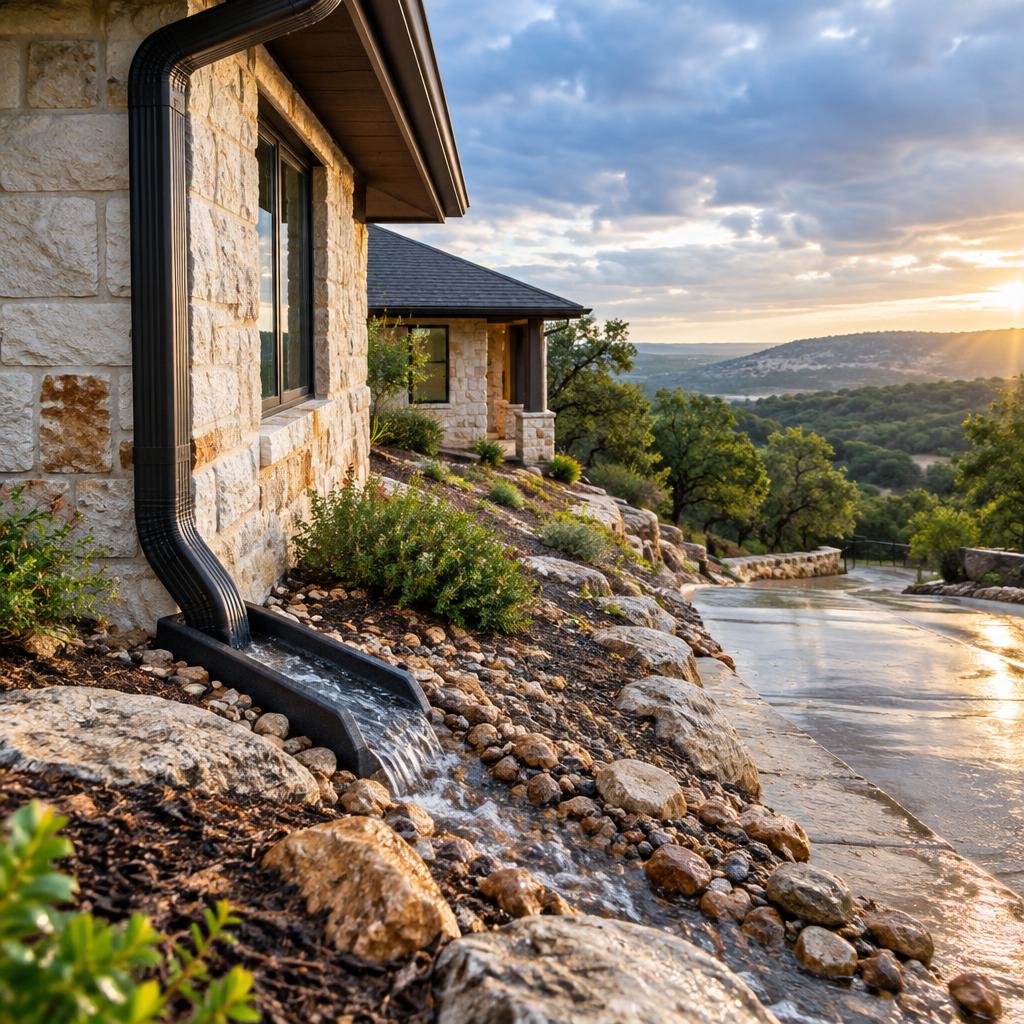
Why local terrain matters for gutters and drainage
The steep slopes, uneven driveways, and rocky soils common across Kerrville and the Texas Hill Country change how water moves around a home. Instead of slowly soaking in, hill-country runoff tends to concentrate and move faster, which increases erosion risk, threatens foundations, and overwhelms standard gutter systems that aren’t sized or routed for concentrated flows. For homeowners, understanding these local conditions is the first step toward a drainage plan that protects landscaping and the structure itself.
How steep driveways and yards change runoff patterns
On slopes, sheet flow from roofs and paved areas can become concentrated into channels as it runs downhill. Driveways and terraces often act like funnels, increasing volume and velocity at low points near the house. That means downspouts placed without consideration for grade may simply deposit water where it can undermine soil or flow into crawlspaces and foundations. Proper design anticipates where runoff will collect and routes it away from vulnerable areas.
The role of rocky, thin soils in erosion and drainage
Rocky or shallow soils typical of the Hill Country have limited infiltration capacity, so more water remains on the surface and moves downslope. Unlike deep, loamy soils, these grounds do not easily absorb high volumes after storms, so even moderate roof runoff can produce rills and washouts. That makes it important to disperse water gently, avoid concentrated discharge points near the house, and use surface solutions that slow and spread flows.
Gutter placement and sizing strategies for sloped sites
Homes on slopes often need larger-capacity gutters and carefully planned downspout locations to handle the increased flow. Seamless gutters reduce overflow risk at joints, and placing downspouts where water can be routed safely downhill prevents pooling at foundation level. In many cases, adding additional downspouts on high-runoff roof planes or installing larger-profile gutters on long slopes is advisable. First Due Gutters and Roofing provides seamless gutter installation and can recommend downspout layouts that reflect local roof geometry and slope conditions.
Downspout discharge options: splash blocks, extensions, and dispersal
How you end water from a downspout matters as much as the gutter itself. Short splash blocks are useful for small grade drops, but on steep lots they may simply push water into concentrated channels. On sloped properties it’s often better to use longer flexible or rigid extensions, daylight the water into a safe swale, or tie into a buried drain line that carries flow downslope to a safe outlet. Where appropriate, dispersal solutions such as shallow rock-lined channels or dry creek beds can slow water and reduce erosion without requiring major grading changes.
Integrating gutters with other site drainage work
Because steep yards and rocky soils can require custom routing, an effective approach combines well-sized gutters and thoughtfully placed downspouts with additional site work—catch basins, buried drainlines, or small detention areas—when needed. First Due Gutters and Roofing focuses on the gutter and roof-side of that equation and will advise when supplemental drainage or landscaping adjustments are recommended. For complex situations, coordinating with a landscaper or civil drainage contractor can ensure the whole system functions together.
Maintenance, contractor selection, and next steps
Regular inspections and cleaning are especially important in the Hill Country: debris can restrict gutters and downspouts so concentrated runoff worsens erosion problems. Choose a contractor who understands local runoff and offers seamless gutters and careful downspout planning—customers in Kerrville and surrounding areas praise First Due Gutters and Roofing for professional workmanship and smooth installations on similar projects. To discuss how slope and soil at your home affect gutter design, contact First Due Gutters and Roofing at (830) 777-7150 or visit https://firstduegutters.com; they serve Kerrville, Comfort, San Antonio and the Texas Hill Country and can help identify practical, site-specific solutions.
Customer review


Article by
First Due Gutters and Roofing
First Due Gutters & Roofing is a firefighter-owned and operated business serving Kerrville, and the surrounding Texas Hill Country. We specialize in residential roofing and seamless gutter systems, including installation, cleaning, and repairs. Our team is dedicated to honest pricing, quality craftsmanship, and dependable service you can trust. Whether it’s a new roof, gutter replacement, or storm damage repair, we respond quickly and treat every home as our own. Built by firefighters, done right the first time.